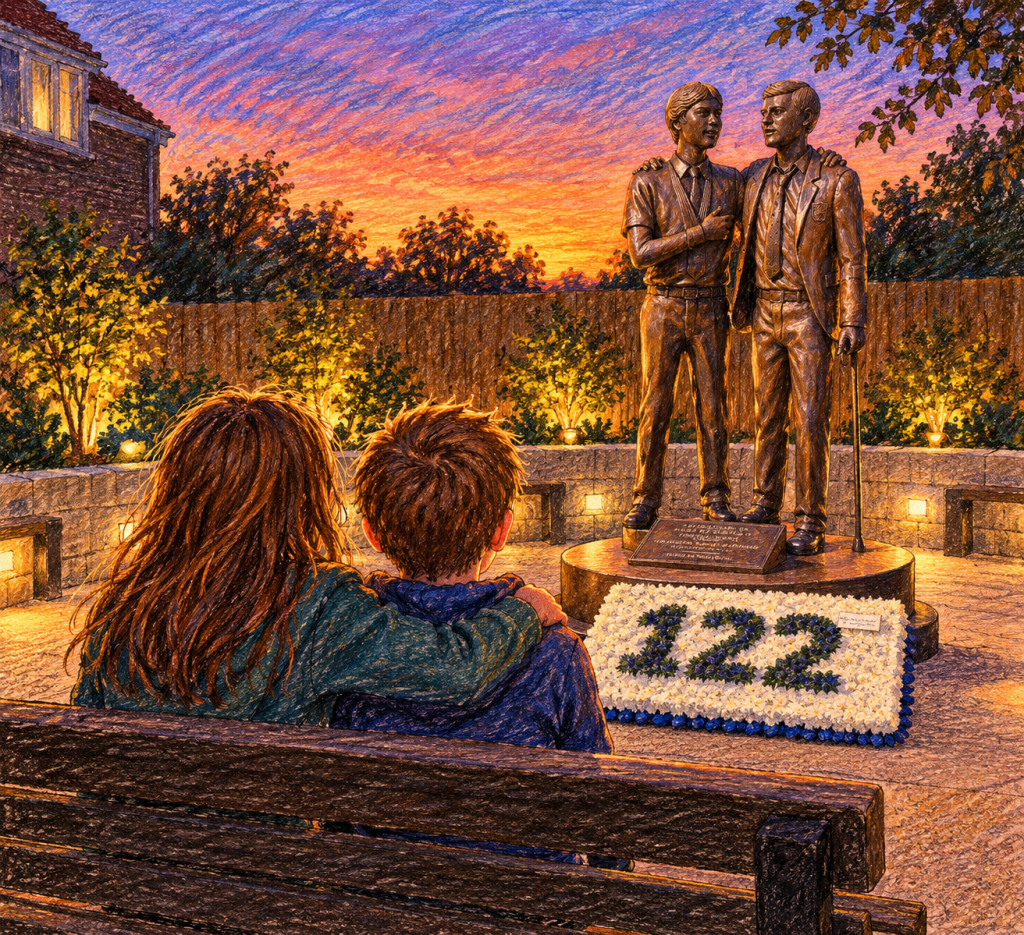
There was one date on this trip that couldn’t move.
26 September 2026.
Everything else could be rearranged. Plans could change, routes could change, people could be visited on different days.
But on 26 September I needed to be in Alton.
It was the day the Treloar Memorial would finally be unveiled.
And it was the reason I had travelled from New Zealand to Britain.
I drove to Alton that morning, but my first stop wasn’t Treloar’s.
It was the florist.
I’d ordered a wreath for Simon and went in to collect it.
The florist brought it out and then asked a perfectly ordinary question.
“Would you like to sign the card?”
I hadn’t expected that to be difficult.
But it was.
Suddenly I was standing in a florist in Alton trying to work out what you write on a card attached to a wreath for your brother who died 38 years ago.
That moment hit me incredibly hard.
Perhaps because there are some things that cut through all the campaigning, meetings, emails, documents and years that have passed.
This wasn’t about any of those things.
This was my little brother.
I wrote the card.
And then I took his wreath to Treloar’s.
I arrived fairly early, which turned out to be something I’m very glad I did.
People gradually began finding each other.
Former Treloar boys were there. Families were there. People from the infected blood community I’d come to know and become friends with over the years were there.
There was this lovely process of connections being made.
Who had been at Treloar when?
Who knew whose brother?
Whose son?
Whose friend?
And then one of the former Treloar boys told me that he had shared a dormitory with Simon.
That stopped me.
Here was somebody standing in front of me who had known my brother in a part of his life that I hadn’t shared with him.
He had slept in the same dormitory.
He remembered him.
After all these years, those tiny connections felt incredibly precious.
They were little pieces of Simon’s life coming back to me.
Then the piper began to play.
The conversations quietened and the ceremony started.
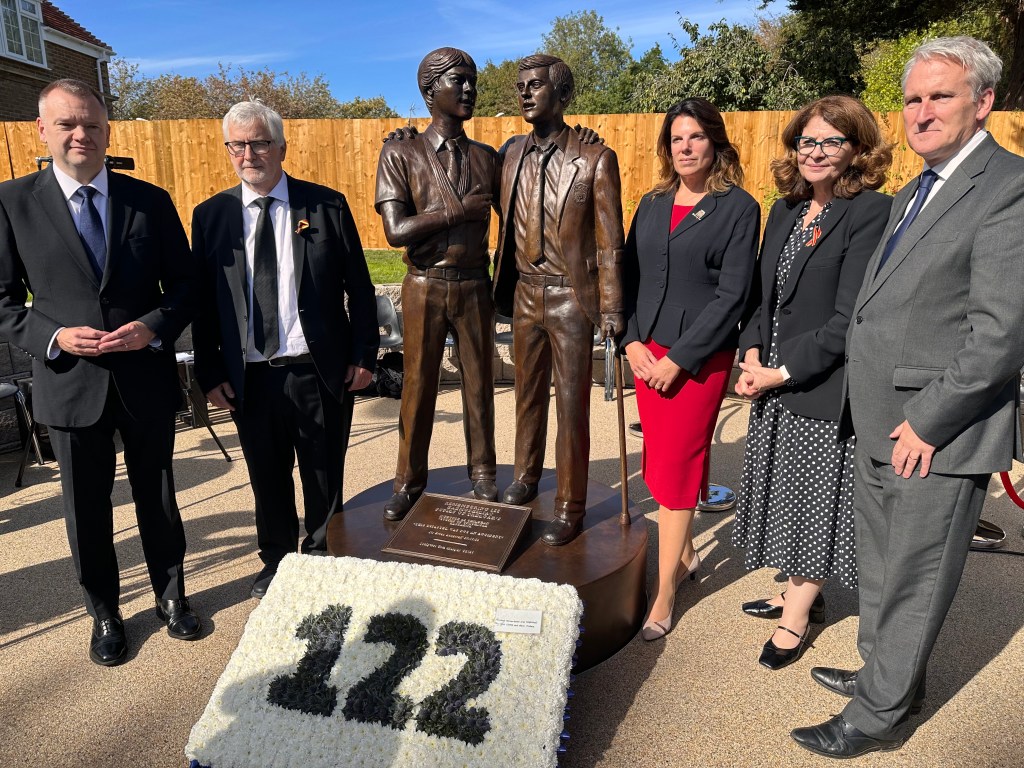
There were speeches, and eventually Sir Brian Langstaff unveiled the memorial.
I’d seen images of what was planned, but seeing it there was different.
Two boys.
Supporting each other.
And what struck me was that neither boy was portrayed as the strong one supporting the weak one.
Both are impaired themselves.
And yet they’re holding each other up.
The more I looked, the more little details I noticed. The expressions, the posture, the tiny nuances that had been worked into it.
It wasn’t simply a monument to something terrible that happened.
It was about the boys.
And standing there amongst the men who survived Treloar’s, and the families of so many who didn’t, that mattered.
The day became extraordinarily busy.
I was interviewed by the BBC and ITV.
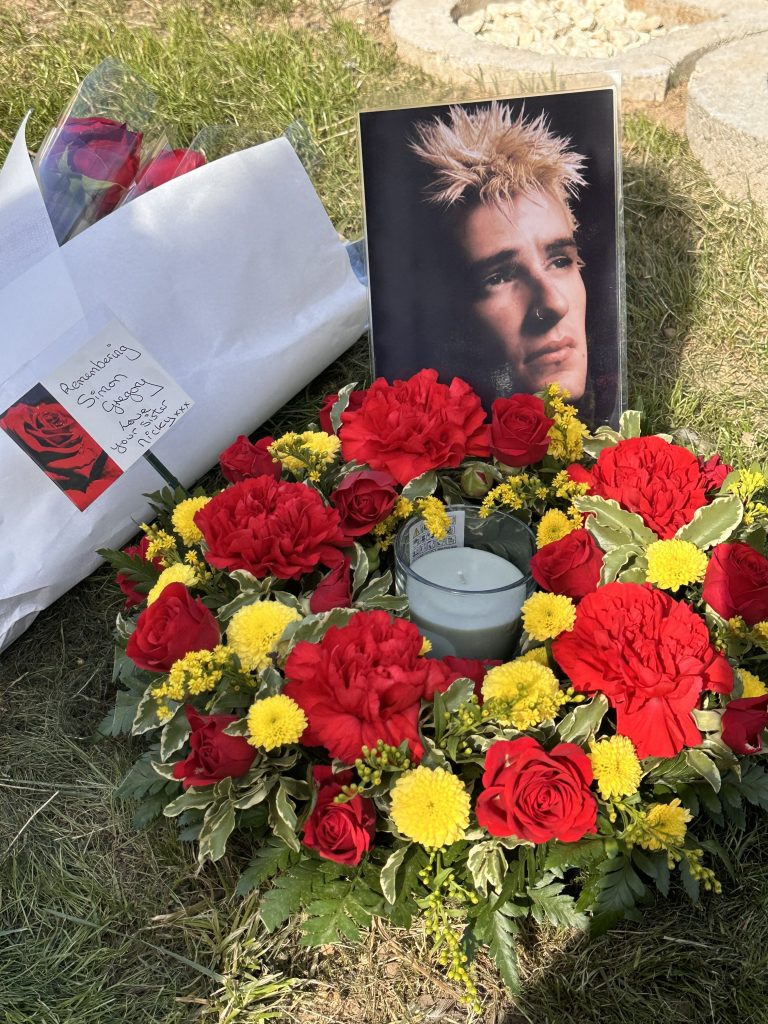
Munjeet and I had both brought photographs of our brothers with us, and the cameras kept focusing in on those photographs.
And I was glad they did.
Because amongst all the interviews, speeches, cameras and people gathered there, there were their faces.
Simon wasn’t simply a name on a memorial or part of the history being discussed that day.
There he was.
My brother.
And beside him, another brother whose family had come to remember him too.
I also spoke with Nick Thomas-Symonds, Dame Diana Johnson and Clive Efford about some of the issues families are still facing.
There were people everywhere whom I’d known through the infected blood community but rarely, or never, had the opportunity to stand beside in person.
Later, many of us ended up back at the White Hart.
At one point I managed to step backwards straight into Sir Brian Langstaff.
Not quite how I’d planned to introduce myself.
But it gave me the opportunity to thank him.
I wanted to do that.
I thanked him for the work he had done and we spoke briefly about some of the problems families are still facing.
I spent time with Munjeet and her mum, with Lee, and with others I’d come to know through years of something none of us would ever have chosen to be part of.
And looking back, that’s what I remember most strongly about the whole day.
Connections.
Connections to Simon.
Connections to the boys who had known him.
Connections between families.
Connections with people I’d known for years through screens, messages, meetings and campaigning.
Connections between those who survived and the families representing those who didn’t.
Even the memorial itself is two boys connected to one another, each with his own difficulties, but each helping to hold the other up.
There was sadness that day, of course.
There couldn’t not be.
Too many boys should have been there themselves.
But it wasn’t a day that felt entirely defined by sadness.
There was warmth.
There was laughter.
There were stories.
There were reunions.
There were names being remembered and little fragments of lives being passed from one person to another.
And there were moments when Simon suddenly felt not quite so far away.
I’d travelled more than halfway around the world to be there.
People had asked me before I left New Zealand why I was coming back to Britain.
There were lots of things I wanted to do while I was here. People I wanted to see. Places I wanted to revisit. Adventures I hadn’t planned yet.
But this was different.
This was the reason I came.
For Simon.
For those boys.
For the people who remember them.
And for one beautiful September day in Alton when, for a few hours, all those separate threads somehow came together.
I will never forget it.


Leave a comment