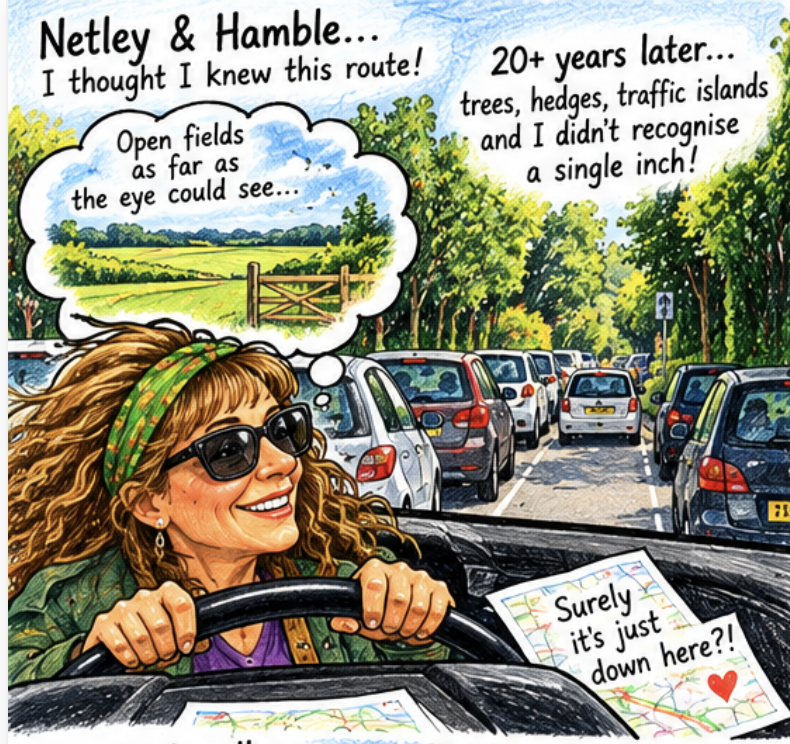
Christine and I set off for Netley and Hamble, an area of Hampshire I used to know extremely well.
Or so I thought.
I’d lived around here many years ago, and although I hadn’t been back for more than 20 years, I was fairly confident I knew where I was going.
After all, roads don’t just disappear, do they?
Well, apparently they do.
Or at least they become completely unrecognisable.
I turned down a lane I remembered very clearly. It used to have lovely open fields stretching away on either side, with views for miles.
Except now there weren’t any fields.
There were trees.
Hundreds of them.
Enormous trees.
Dense hedges.
Traffic islands.
More trees.
Whoever had been in charge of this particular stretch of Hampshire had apparently decided that the best thing to do was plant an entire forest and then hide the road inside it.
I couldn’t see a thing.
Not a single familiar view.
Twenty-odd years ago, I could have looked across those fields and recognised exactly where I was.
Now I could have been anywhere.
And it continued.
Roads had been altered. New housing estates had appeared. Apartment blocks had sprung up. There were road names I’d never heard of.
Entire neighbourhoods seemed to have been invented while I’d been away.
I began to wonder whether I was actually in Netley at all.
Perhaps Christine had quietly taken me somewhere else.
I wouldn’t put it past her.
The Great British Driving Challenge
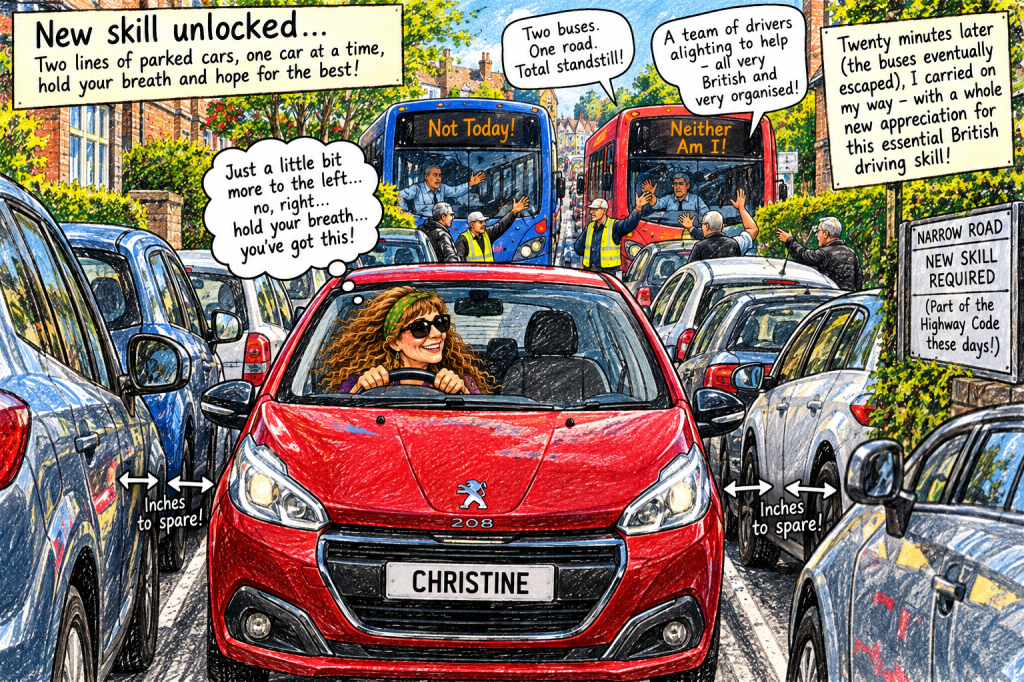
Then I encountered something else that appears to have developed considerably since I last lived in Britain.
The suburban obstacle course.
Now, I remember parked cars.
Obviously.
But apparently the modern British approach to residential parking is to line both sides of the road with vehicles until the remaining gap is barely wide enough for a child on a scooter.
Then you attempt to drive through it.
This requires a very specialised set of skills.
First, you assess the gap.
Then you look for approaching traffic.
Then you make a judgement about whether you can get through before the other driver reaches you.
Then you hold your breath.
Some people may prefer crossing their fingers.
Others probably pray.
Personally, I find a combination of all three quite useful.
If everything goes according to plan, one driver flashes their headlights, the other proceeds, and there is an elaborate exchange of hand-waving to acknowledge the kindness.
Thank you!
No, thank YOU!
Lovely!
If things don’t go according to plan, I’m reliably informed that an entirely different form of hand signalling may be employed.
Apparently this is all part of the Highway Code now.
Section 47B: Negotiating the Suburban Slalom.
Or something like that.
I was becoming quite proficient at it.
Until I encountered two buses.
Two enormous buses.
Both attempting to negotiate a series of traffic-calming chicanes.
From opposite directions.
At the same time.
Oh dear.
Neither could go forward.
Neither could go backwards.
And neither was particularly interested in disappearing.
Before long, drivers began climbing out of their cars to assist.
A sort of impromptu traffic management committee formed in the middle of the road.
There was pointing.
Waving.
Discussion.
More pointing.
People directing buses backwards.
Cars being shuffled around.
It was like watching a very complicated game of Tetris, except all the pieces weighed several tonnes and nobody could find the restart button.
I sat in Christine watching the proceedings.
I’d only come this way for a little trip down memory lane.
Instead, I’d become an unwilling participant in a large-scale logistical exercise involving two buses and half the local population.
Twenty minutes later, order was finally restored.
The buses escaped.
The traffic moved.
And Christine and I continued our journey.
So much for nostalgia.
Not Quite the Place I Remembered
It’s been strange coming back to somewhere that was once so familiar.
In my head, Netley and Hamble were still exactly as I’d left them.
The open fields were still there.
The roads were the same.
The villages hadn’t changed.
Of course, more than 20 years have passed.
Trees have grown.
Houses have been built.
Roads have been rearranged.
And apparently somebody has decided that every residential street should double as a driving proficiency test.
I suppose that’s what happens when you leave somewhere for more than two decades. The place carries on perfectly well without you, while you’ve kept an old version of it tucked away in your head.
Still, I did eventually find my way to my friends’ house.
And thankfully, unlike the roads, they hadn’t changed a bit.
But that’s another story.
For now, I’ve learnt two things.
Firstly: Never assume you know your way around somewhere just because you lived there 20 years ago.
Secondly: If you’re planning to drive through the suburbs of Hampshire, make sure you’ve mastered the art of squeezing between parked cars, negotiating chicanes and communicating through an elaborate system of headlight flashes and hand gestures.
And if you see two buses approaching each other on a narrow road…
Put the kettle on.
You could be there for some time.


Leave a Reply